

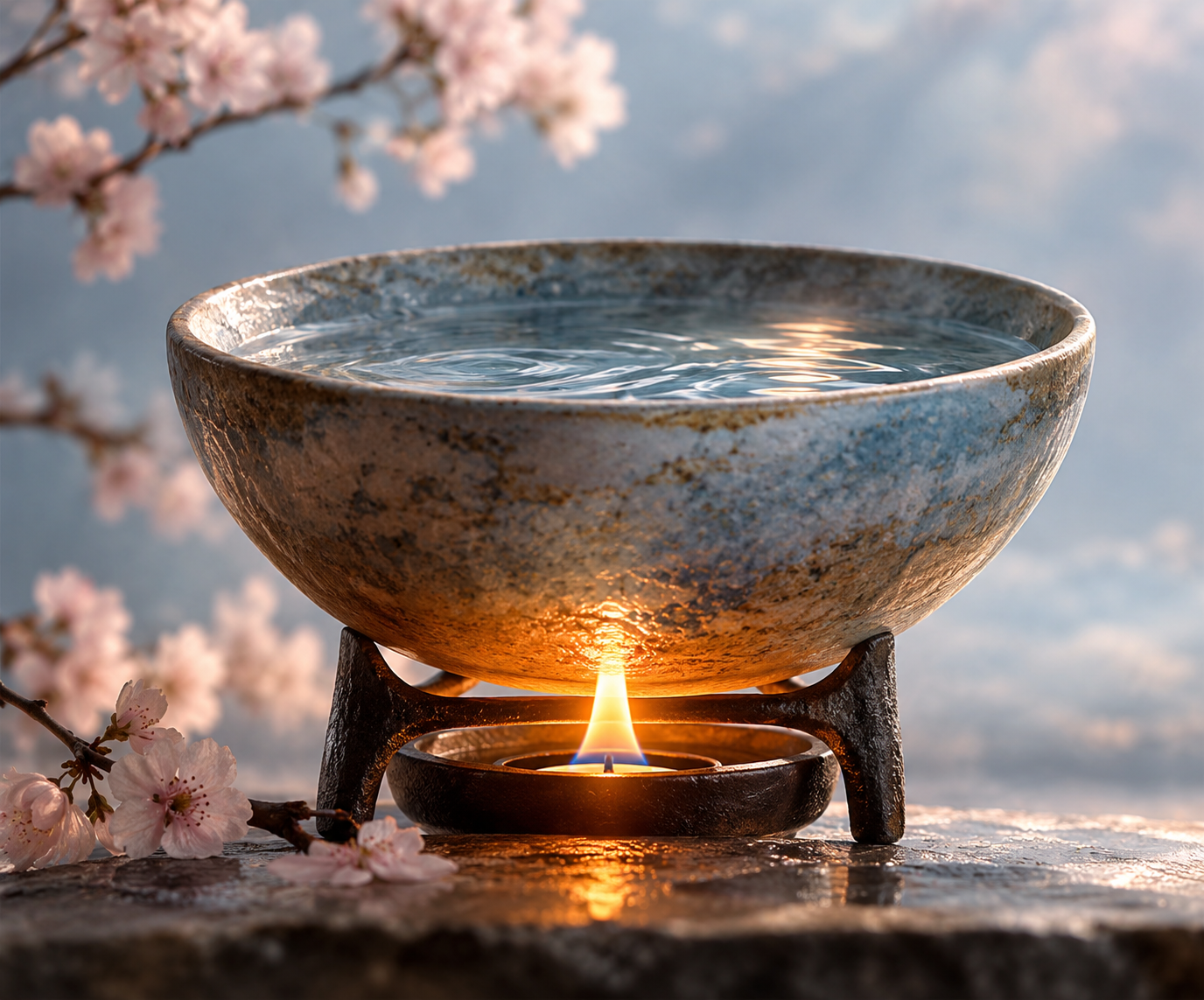
The flame does not direct the water
Imagine a flame beneath a vessel of water. The flame does not instruct the water to move. It does not determine its direction, its rhythm, or the nature of its transformation. It simply provides energy. And the water begins to move. There is something profound in this relationship. The flame does not become the water. It does not take credit for the movement. It does not need to understand every current or ripple that arises. Its presence creates the conditions for movement.
This is how I understand healing. Healing Is a Living Process. For more than thirty years, I have explored the relationship between life-force energy, the physical body, emotion, consciousness, spirit, and nature. Through Jin Shin Jyutsu, Reiki, and Shamanic practice, I have come to understand healing not as something we impose upon another person, but as a living process that belongs to the individual. Healing may be experienced physically, mentally, emotionally, and spiritually. These dimensions of our being are not isolated from one another. What we experience in one area of life can influence how we experience another.
Yet healing does not necessarily follow a predictable path. Sometimes there is movement where we expected stillness. Sometimes an emotion surfaces when we thought we were addressing something physical. Sometimes what we encounter is silence. The experience does not always reveal itself in the way we anticipate. The Role of the Healer I do not believe the role of a healer is to direct another person's healing or decide what must change. The practitioner tends the flame.
Within Kokoro Healing, I work with life-force energy through three complementary traditions. Jin Shin Jyutsu brings awareness to the relationship between energy and the physical body—what I describe as spirit into matter. Reiki represents a fundamental frequency of life-force energy within my healing philosophy. Shamanic practice recognizes spirit within nature and the possibility of communication and relationship with the living world. Together, these practices form the foundation of Kokoro Healing. They are not intended to force an outcome, but to create conditions in which the individual's own natural movement toward balance and restoration may unfold. It is important to witness.
We often approach healing with an expectation. We want something to disappear. A pain, an emotion, a memory, a fear. And understandably so. But what happens when we allow ourselves to observe an experience before attempting to change it? What happens when we become curious about the movement rather than immediately judging its direction?
Witnessing is not the absence of participation. It is a conscious relationship with what is taking place. This is also why I believe journaling can be a meaningful companion to healing. Writing allows us to recognize experiences, notice patterns, and give expression to what may otherwise remain unspoken. Not everything we discover needs an immediate explanation. Sometimes awareness itself is the beginning of a different relationship with our experience.
Kokoro is a Japanese word encompassing heart, mind, and spirit. To me, it speaks to the living relationship between our physical existence, our emotional experiences, our consciousness, and our connection to something greater than ourselves. Kokoro healing was born from the understanding that these dimensions are interconnected and that healing may unfold through any of them.
The flame provides the energy. The water responds according to its own nature. And the movement belongs to the water. The practitioner tends the flame. The movement belongs to you.
An Invitation to Reflect: Take a few moments to consider: Where in my life am I trying to force movement? What might I discover if I allowed myself to observe rather than direct? What does healing mean to me beyond the absence of discomfort? You do not need to arrive at an answer. Simply begin with awareness.
Tend the flame. Witness the water.
-Christina